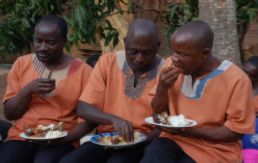
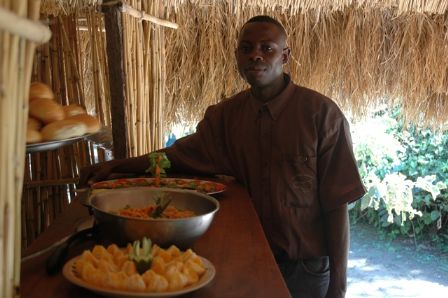
Kiboko Town Hotel Lloyd, Flayer and Supu tasting their own lunch
Kiboko Team News
Kiboko Safaris now offers 2 and 3 days all inclusive weekend safaris to South Luangwa NP. Leaving on Friday or Saturday coming back on Sunday you will experience the best Zambia has to offer.
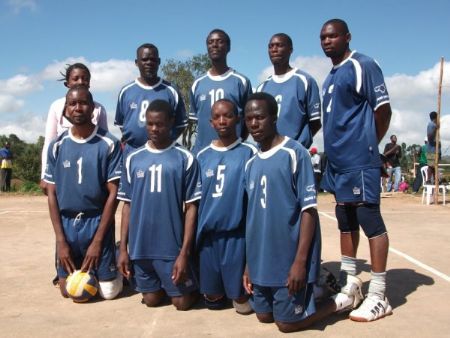
24 April 2012, The Kiboko Volleybal Team is competing to hold the head position in the A -league volleybal competition in Lilongwe. Well done!
05 April 2012, Head chef Dabson Nkhoma has been nominated as employee of the month for his hard and dedicated work for Kiboko Safaris Zambia.
Thanks so much Dabson and keep up the good work.
<< PrevNext >>
123
About Kiboko
Kiboko Safaris Malawi, the Kiboko Town Hotel and the Africa house staff members are enthusiastic and dedicated to their jobs and what they do within the company. They are all trying their level best within their knowledgeable capacities to ensure that you as our client will have a great experience during your stay or safari with us. Have a look below for more interesting details about our well-beloved staff members.
Kiboko Safaris Malawi:
Edson Banda is our operations manager who is well known for his wise decisions and thoughtful comments. Edson has been with Kiboko for almost 10 years now and has extensive knowledge of vehicles, accounts and staff management.
Donia is our secretary. She will welcome you at our workshop and help you with your questions.
Francis Kamoto is our workshop manager and still an active safari driver. Francis is one of the best mechanics in the safari trade. He is a senior staff member and enjoys taking guests on safari so much he does not want to stop driving.
Zakeyu Mvalenti is our latest mechanic. He works hard to keep our vehicles up and running.
Banja Mazoni is a different story. Having started out as a cleaner in the company and not speaking any English when first coming to work for Kiboko in 1998, Banja is now leading a building team of 15 people for Kiboko!
Ernest Nkhoma is the assistant to our main mechanic. Also a tyre specialist, he is the reason why the vehicles run perfectly and the tyres last long.
Stanley Mbewe (left) is the company welder and one of Kibokos oldest employees. Exact as he is, any repairs on our vehicles are done with utmost precision!
Japhet Phiri is one of the cooks for Kiboko Safaris. He prepares really delicious food while on safari. He loves his job and is a perfectionist in what he does.
Liveness likes to see everything clean in our tented camp. Beddings, towels and tents you name it, she cleans it.
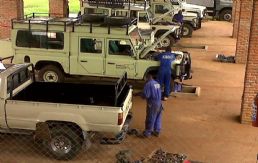
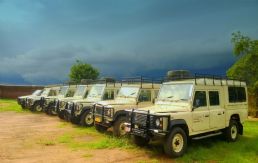
The Safari fleet!
The Kiboko Town Hotel Team
Our oldest employee and a real ‘madala’ as the Malawians would say, is Mr. Lyforce Banda. He is our head cleaner and has been working at Kiboko Town Hotel from the start. After all these years he still loves his job, he knows all the guests and they know him.
With his 4 years Kiboko experience and 9 years total cleaning experience Joseph knows how to clean and to make the guests happy with his smile. He likes working in the hospitality industry and sometimes you will even find him dancing around the hotel.
Manfred has been working with Kiboko for over 3 years now, but has 10 years cooking experience. He says his specialties are chicken macaroni and stir fried beef. Modest as he is, we think he is a very good pastry chef too.
Bernard likes to work at Kiboko because he has fun with his colleagues. He says it is a great team!
Charles is a hard worker with a passion for food. He has been working as a chef for a long time and makes delicious meals. Besides working at the hotel we sometimes send him along with guests on our camping safaris throughout Malawi and our guests love him and his food.
Pamela is the face of our reception. She’s very good with things like Booking.com and most of our guests know her!
After 9 years Lonely is still working at Kiboko. She worked in different departments, but now she is a waitress in our restaurant. She likes her colleagues. In the future she hopes to learn more about safaris and business administration.
Our always happy and outgoing waitress is called Stella. In the future she hopes to study Hotel and Management to learn more about hospitality and business. Meeting new people from abroad every day and to learn about their culture is what she likes in a job.
.
Mr. Blackson has been working with Kiboko for 14 years now and is very loyal to the hotel. As a messenger he rides with his bike through Lilongwe as fast as he can. He still thinks every day is a new adventure and he is a very reliable staff member.
Mr. Rabson has some green fingers. He knows a lot about trees, plants and flowers. He keeps the garden clean and green and does this with a big smile. The garden was so clean that we decided to promote him to housekeeping!
Erick is the handyman, he works hard and tries his best to learn English.
Nelie is our newest housekeeper, she makes sure that all sheets and pillow cases are spotless.
Welcome to Malawi
Malawi is a great country to visit on your holidays. Although some people feel Malawi doesn’t have the great safari options that East and Southern Africa have, travellers may be pleasantly surprised and many stay a lot longer than planned. For such a tiny country (no bigger in size than England), Malawi offers a wide variety of attractions: lakes, mountains, forests, game parks and villages. The main feature of the country, and its primary attraction is Lake Malawi, an enormous freshwater inland sea. The Lake Malawi National Park is the world’s first freshwater park and a UNESCO World Heritage Site. There are over 550 species of fish, most of them unique to these waters. A number of tourist resorts and hotels have been established on the lakeshore. The more luxurious can be found on the southern lakeshore while in the northern part a number of rustic resorts close to the traditional villages are found. They are great places to enjoy water based activities, such as diving and snorkelling, boat rides or simply relaxing in a hammock on the beach.
There are five national parks in Malawi, wildlife such as elephants, zebras, hippos and crocodiles are found there. Few Malawians have ever had the chance to visit their national parks and many have never seen some of the animals for which East Africa is famous. Malawi also offers good hiking and trekking in some of the parks such as the Nyika Plateau National Park in the north. Here for example, you can go horse riding on the grassy plains. Mount Mulanje, on Malawi’s south-eastern border with Mozambique, offers challenging treks to the summit as Africa’s second highest mountain!
Malawi is a good place to buy African curios at reasonable prices and the craftspeople are very inventive. They are known for their basketwork and there are few other places in the world where you can pick up a grass helicopter complete with rotating blades or a Land Rover with a spare wheel fully made out of grass. Malawi is also known for its wood carvings. This is where the famous Malawi chair is made, a very popular souvenir coming out of Africa. A good place to buy one is at the curios market in Lilongwe, the country’s capital.
Describing themselves as ‘the friendliest people in Africa’, all of the Malawian ethnic groups live harmoniously together. Some Malawian elders attribute this to the 19th century Scottish missionary, Dr David Livingstone. He arrived in Malawi in 1859 and encouraged the chiefs to work together to end the slave trade. Today Malawi is a warm and welcoming country that offers visitors great scenery and some of the friendliest people in all of Africa. There is also a refreshingly relaxed and laid-back atmosphere as most people spend their time working on the land or fishing in the lake. The pace of life in Malawi is timeless. The cries of fish eagles, the fishermen in dugouts silhouetted against the evening skies and the warm, sleepy atmosphere make it impossible not to relax. If you get the chance to sit on the beach and watch the sun sink into Lake Malawi as fisherman return to shore with the day’s catch, you’ll understand what we mean. Malawi makes a great stand-alone destination but also combines well with Zambia to which it is well connected. Zambia, with its vast parks and wild nature, makes a wonderful contrast to the gentler Malawi.
What does Malawi look like? Malawi is a landlocked country bordered by Tanzania, Zambia and Mozambique, but it’s not short of water thanks to Lake Malawi – the world’s ninth largest lake. Lake Malawi dominates the whole country; it is the country’s centrepiece. It’s like an inland sea with endless beaches, enclosed by sheer mountains – undeniably the focal point for travellers to this country.
Malawi is a narrow but long country, approximately 850km long and 160km wide. It lies at the southern end of the Great Rift Valley. Lake Malawi is the southernmost lake in a series of lakes marking the valley’s route south from the Red Sea. The entire country covers an area of 118.000 sq km, making it slightly smaller than England. Malawi has a thickly forested high central plateau with a mountainous spine rising to 2600 metres. The highest point is Mount Mulanje in the south east, which rises to over 3200 metres. The countryside is mainly rough scrub with a surprising lack of trees. A lot have been chopped down for firewood and to make charcoal, and they haven’t been replaced. Some, such as the indigenous ebony trees, are chopped down to make wood souvenirs – worth thinking about when you’re buying a Malawian chair.
Historically, Malawi was called Maravi, meaning ‘reflected light’. Perhaps this referred to the brilliant glitter on Lake Malawi as the sun shines on it. Throughout history, people have been attracted to the region by its stable climate, regular rainfall and the ample supply of fish in the lake. Before Arab and Portuguese slave traders penetrated central Africa and caused havoc in the 18th century, people lived undisturbed in kingdoms governed by chiefs. Dr David Livingstone first set eyes on the great lake in 1859. By 1875 the Scottish Presbyterian Church had founded its first mission at Cape Maclear, followed by more European settlers who began to farm the land. With the growth of commerce and expanding plantations, Malawians migrated towards the settlers’ farms in search of work, and towns and villages were established. Colonial domination became inevitable, and in 1891 the British declared the country the British Protectorate of Nyasaland.
In 1953 the British federated Nyasaland with Northern and Southern Rhodesia (now Zambia and Zimbabwe). Nyasaland seceded in 1963, following elections won by Dr Hastings Kamuzu Banda and his Malawi Congress Party. Nyasaland became independent from Britain in 1964 and was renamed Malawi. Two years later Kamuzu Banda declared the country a republic and a one-party state. His regime was harsh and by 1971 he had declared himself President for Life. Any opponents of his government were thrown in jail or banished from the country. His policies were off the wall: it was against the law for men to have long hair and for women to wear anything but skirts. Banda’s foreign policy also attracted widespread international criticism as he supported the apartheid regime in South Africa – the only black-ruled African state to do so. This cosy relationship with South Africa funded the construction of the new capital city, Lilongwe in 1975. The old capital being Zomba.
In 1992 Malawi experienced an acute shortage of food because of poor harvests which were affected by drought and the need to provide food for some one million refugees who had fled war in Mozambique. People demanded change, and by 1993, the ailing Banda was forced to concede. A referendum in June endorsed the transition to a multi-party democracy with a new constitution. Elections were held in 1994 and were won by Dr Bakili Muluzi while Kamuzu Banda was recovering from brain surgery in South Africa. When he returned to Malawi, the ageing Banda and his chief henchman, the much-hated and feared John Tembo, were put on trial for their alleged role in the 1983 murders of four opposition politicians. The trial ended inconclusive upon Banda’s death in 1997. In the 1999 elections Muluzi won a second term in office. In 2004 Bingu wa Mutharika was announced the successor of Muluzi and he won the Elections held that same year. He was re-elected in 2009, but died unexpectedly in April 2012 of a heart attack, His successor was Joyce Banda the first female president of Southern Africa. She was in office until 2014, when the brother of the late Bingu wa Mutharika, Arthur Peter Mutharika, was elected.
Malawi is one of the poorest counties on earth, and most of the thirteen million people rely on subsistence farming or fishing to survive. Drought and poor harvests in recent years have led to shortages of maize, the country’s staple food. Malawi often has to look south to the richer nations for food aid. Despite this, Malawi is doing the best it can to improve their situation under the new government and the Malawian people are generally happy and friendly. Any traveller to Malawi will be made to feel most welcome to taste an unforgettable Africa Experience.
Zambia, officially the Republic of Zambia, is a landlocked country in Southern Africa. The neighbouring countries are the Democratic Republic of the Congo to the north, Tanzania to the north-east, Malawi to the east, Mozambique, Zimbabwe, Botswana and Namibia to the south, and Angola to the west.
The capital city is Lusaka, located in the south-central part of the country. The population is concentrated mainly around Lusaka in the south and the Copperbelt Province to the northwest. Originally inhabited by Khoisan peoples, the region which comprises modern Zambia was colonised during the Bantu expansion of the thirteenth century. After visits by European explorers in the eighteenth century, Zambia became the British colony of Northern Rhodesia towards the end of the nineteenth century. For most of the colonial period, the country was governed by an administration appointed from London with the advice of the British South Africa Company. On 24 October 1964, the country declared independence from the United Kingdom and then-prime minister Kenneth Kaunda became the inaugural president. Kaunda’s socialist United National Independence Party (UNIP) maintained power from the 1964 until 1991. From 1972 to 1991 Zambia was a single-party state with the UNIP as the sole-legal political party, with the goal of uniting the nation under the banner of ‘One Zambia, One Nation’. Kaunda was succeeded by Frederick Chiluba of the social-democratic Movement for Multi-Party Democracy in 1991, during which the country saw a rise in social-economic growth and increased decentralisation of government. Chiluba’s privatisation of the mines backfired when investors closed operations. He attempted to run for an unconstitutional third term, which was stopped by mass protests. Chiluba selected Levy Mwanawasa as his successor, Mwanawasa presided over the country from January 2002 until his death in August 2008. Mwanawasa is credited for initiating a campaign to reduce corruption and increase the standard of living from those left by his predecessor. After Mwanawasa’s death, Rupiah Banda served as acting president before officially being elected president in 2008. He is the shortest serving president, having held office for only three years. Patriotic Front party leader, Michael Chilufya Sata defeated Banda in the 2011 elections. In 2010, the World Bank named Zambia one of the world’s fastest economically reformed countries. The Common Market for Eastern and Southern Africa (COMESA) is headquartered in the capital Lusaka.
Geography of Zambia
Victoria Falls is by some measures the largest waterfall in the world, being twice as wide and one and a half times as high as the Niagara Falls. Zambia is a landlocked country in southern Africa, with a tropical climate and consists mostly of high plateau, with some hills and mountains, dissected by river valleys. At 752,614 km2 (290,586 sq mi) it is the 39th-largest country in the world (after Chile) and slightly larger than the US state of Texas. Zambia is drained by two major river basins; the Zambezi/Kafue basin in the centre, west and south covering about three-quarters of the country; and the Congo basin in the north covering about one-quarter of the country.
A very small area in the northeast forms part of the internal drainage basin of Lake Rukwa in Tanzania. In the Zambezi basin, there are a number of major rivers flowing wholly or partially through Zambia; the Kabompo, Lungwebungu, Kafue, Luangwa, and the Zambezi itself, which flows through the country in the west and then forms its southern border with Namibia, Botswana and Zimbabwe. Its source is in Zambia but it diverts into Angola, and a number of its tributaries rise in Angola’s central highlands. The edge of the Cuando River floodplain (not its main channel) forms Zambia’s southwestern border, and via the Chobe River that river contributes very little water to the Zambezi because most is lost by evaporation. Two of the Zambezi’s longest and largest tributaries, the Kafue and the Luangwa, flow mainly in Zambia. Their confluences with the Zambezi are on the border with Zimbabwe at Chirundu and Luangwa town respectively. Before its confluence, the Luangwa River forms part of Zambia’s border with Mozambique. From Luangwa town, the Zambezi leaves Zambia and flows into Mozambique, and eventually into the Mozambique Channel. The Zambezi falls about 100 metres (328 ft) over the 1.6 km (0.99 mi) wide Victoria Falls, located in the south-west corner of the country, subsequently flowing into Lake Kariba. The Zambezi valley, running along the southern border, is both deep and wide. From Lake Kariba going east it is formed by grabens and like the Luangwa, Mweru-Luapula, Mweru-wa-Ntipa and Lake Tanganyika valleys, is a rift valley.
The north of Zambia is very flat with broad plains. In the west the most notable being the Barotse Floodplain on the Zambezi, which floods from December to June, lagging behind the annual rainy season (typically November to April). The flood dominates the natural environment and the lives, society and culture of the inhabitants and those of other smaller, floodplains throughout the country. In Eastern Zambia the plateau which extends between the Zambezi and Lake Tanganyika valleys is tilted upwards to the north, and so rises imperceptibly from about 900 m (2,953 ft) in the south to 1,200 m (3,937 ft) in the centre, reaching 1,800 m (5,906 ft) in the north near Mbala. These plateau areas of northern Zambia have been categorised by the World Wildlife Fund as a large section of the Central Zambezian Miombo woodlands ecoregion. Eastern Zambia shows great diversity. The Luangwa Valley splits the plateau in a curve north east to south west, extended west into the heart of the plateau by the deep valley of the Lunsemfwa River. Hills and mountains are found by the side of some sections of the valley, notably in its north-east the Nyika Plateau (2,200 m/7,218 ft) on the Malawi border, which extend into Zambia as the Mafinga Hills, containing the country’s highest point, Kongera (2,187 m/7,175 ft). The Muchinga Mountains, the watershed between the Zambezi and Congo drainage basins, run parallel to the deep valley of the Luangwa River and form a sharp backdrop to its northern edge, although they are almost everywhere below 1,700 m (5,577 ft). Their culminating peak Mumpu is at the western end and at 1,892 m (6,207 ft) is the highest point in Zambia away from the eastern border region. The border of the Congo Pedicle was drawn around this mountain. The southernmost headstream of the Congo River rises in Zambia and flows west through its northern area firstly as the Chambeshi and then, after the Bangweulu Swamps as the Luapula, which forms part of the border with the Democratic Republic of the Congo. The Luapula flows south then west before it turns north until it enters Lake Mweru. The lake’s other major tributary is the Kalungwishi River, which flows into it from the east. The Luvua River drains Lake Mweru, flowing out of the northern end to the Lualaba River (Upper Congo River). Lake Tanganyika is the other major hydrographic feature that belongs to the Congo basin. Its south-eastern end receives water from the Kalambo River, which forms part of Zambia’s border with Tanzania. This river has Africa’s second highest uninterrupted waterfall, the Kalambo Falls.
Climate of Zambia
The climate of Zambia is tropical modified by elevation. In the Köppen climate classification, most of the country is classified as humid subtropical or tropical wet and dry, with small stretches of semi-arid steppe climate in the south-west and along the Zambezi valley. There are two main seasons, the rainy season (November to April) corresponding to summer, and the dry season (May/June to October/November), corresponding to winter. The dry season is subdivided into the cool dry season (May/June to August), and the hot dry season (September to October/November). The modifying influence of altitude gives the country pleasant subtropical weather rather than tropical conditions during the cool season of May to August. However, average monthly temperatures remain above 20 °C (68 °F) over most of the country for eight or more months of the year.
History of Zambia
The area of modern Zambia was inhabited by Khoisan hunter-gatherers until around AD 300, when more technologically advanced migrating ethnic groups began to displace or absorb them. In the 12th century, major waves of Bantu-speaking immigrants arrived during the Bantu expansion. Among them, the Tonga people (also called Ba-Tonga, “Ba-” meaning “woman”) were the first to settle in Zambia and are believed to have come from the east near the “big sea”. The Nkoya people also arrived early in the expansion, coming from the Luba–Lunda kingdoms located in the southern parts of the modern Democratic Republic of the Congo and northern Angola, followed by a much larger influx, especially between the late 12th and early 13th centuries. In the early 19th century, the Nsokolo people settled in the Mbala district of Northern Province. During the 19th century, the Ngoni and Sotho peoples arrived from the south. By the late 19th century, most of the various peoples of Zambia were established in the areas they currently occupy. The arrival of Europeans was just yet another such influx.
A statue of David Livingstone on the Zambian side of Victoria Falls. The earliest account of a European visiting the area was Francisco de Lacerda in the late 18th century, followed by other European visitors in the 19th century. The most prominent of these was David Livingstone, who had a vision of ending the slave trade through the “3 Cs” (Christianity, Commerce and Civilization). He was the first European to see the magnificent waterfall on the Zambezi River in 1855, naming them “Victoria Falls” after Queen Victoria – he described them thus: “Scenes so lovely must have been gazed upon by angels in their flight”. Locally the falls are known as “Mosi-o-Tunya” or “(the) thundering smoke” (in the Lozi or Kololo dialect). The town of Livingstone, near the Falls, is named after him. Highly publicised accounts of his journeys motivated a wave of European visitors, missionaries and traders after his death in 1873. In 1888, the British South Africa Company (BSA Company), led by Cecil Rhodes, obtained mineral rights from the Litunga, the Paramount Chief of the Lozi or Ba-rotse for the area which later became North-Western Rhodesia. To the east, in December 1897 a section of the Angoni or Ngoni (originally from Zululand) under Tsinco, the son of King Mpezeni, rebelled, but the rebellion was put down, and Mpezeni accepted the Pax Britannica. That part of the country then came to be known as North-Eastern Rhodesia. In 1895, Rhodes asked his American scout Frederick Russell Burnham to look for minerals and ways to improve river navigation in the region, and it was during this trek that Burnham discovered major copper deposits along the Kafue River.
Liberation statue in front of a government building North-Eastern Rhodesia and North-Western Rhodesia were administered as separate units until 1911 when they were merged to form the British Colony of Northern Rhodesia. In 1923, the BSA Company ceded control of Northern Rhodesia to the British Government after the government decided not to renew the Company’s charter. That same year, Southern Rhodesia (now Zimbabwe), a conquered territory which was also administered by the BSA Company, became a self-governing British Dominion. In 1924, after negotiations, administration of Northern Rhodesia transferred to the British Colonial Office. In 1953, the creation of the Federation of Rhodesia and Nyasaland grouped together Northern Rhodesia, Southern Rhodesia and Nyasaland (now Malawi) as a single semi-autonomous region. This was undertaken despite opposition from a sizeable minority of the population, who demonstrated against it in 1960–61. Northern Rhodesia was the centre of much of the turmoil and crisis characterizing the federation in its last years. Initially, Harry Nkumbula’s African National Congress (ANC) led the campaign that Kenneth Kaunda’s United National Independence Party (UNIP) subsequently took up. A two-stage election held in October and December 1962 resulted in an African majority in the legislative council and an uneasy coalition between the two African nationalist parties. The council passed resolutions calling for Northern Rhodesia’s secession from the federation and demanding full internal self-government under a new constitution and a new National Assembly based on a broader, more democratic franchise. The federation was dissolved on 31 December 1963, and in January 1964, Kaunda won the first and only election for Prime Minister of Northern Rhodesia. The Colonial Governor, Sir Evelyn Hone, was very close to Kaunda and urged him to stand for the post. Soon after, there was an uprising in the north of the country known as the Lumpa Uprising led by Alice Lenshina – Kaunda’s first internal conflict as leader of the nation. Northern Rhodesia became the Republic of Zambia on 24 October 1964, with Kaunda as the first president. At independence, despite its considerable mineral wealth, Zambia faced major challenges. Domestically, there were few trained and educated Zambians capable of running the government, and the economy was largely dependent on foreign expertise. There were over 70,000 British in Zambia in 1964, who were of great economic importance. During the next decade, Kaunda’s regime supported movements such as UNITA in Angola; the Zimbabwe African People’s Union (ZAPU); the African National Congress (ANC) in South Africa; and the South West Africa People’s Organization (SWAPO). Kaunda developed close relations with communist regimes in the Soviet Union and the People’s Republic of China. Kaunda also developed a close friendship with Iraqi dictator Saddam Hussein. Kaunda’s support for the insurgents attacking neighbouring Rhodesia, and the setting up of training camps for them in Zambia resulted in cross-border raids in both directions, leading to the closure of the border with Rhodesia in 1973 and severe problems with international transport and power supply. However, the Kariba hydroelectric station on the Zambezi River provided sufficient capacity to satisfy the country’s requirements for electricity (despite the fact that the control centre was on the Rhodesian side of the border). A railway to the Tanzanian port of Dar es Salaam, built with Chinese assistance, reduced Zambian dependence on railway lines south to South Africa and west through an increasingly troubled Angola. Until the completion of the railway, however, Zambia’s major artery for imports and the critical export of copper was along the TanZam Road, running from Zambia to the port cities in Tanzania. The Tazama oil pipeline was also built from Dar es Salaam to Ndola in Zambia. By the late 1970s, Mozambique and Angola had attained independence from Portugal. Zimbabwe achieved independence in 1980 in accordance with the 1979 Lancaster House Agreement. Zambia’s problems, however, were not solved. Civil war in the former Portuguese colonies created an influx of refugees and caused continuing transportation problems. The Benguela railway, which extended west through Angola, was essentially closed to traffic from Zambia by the late 1970s. Zambia’s strong support for the ANC (despite both the Zambian ANC and the SA ANC being banned within Zambia), which had its external headquarters in Lusaka, created security problems as South Africa raided South African ANC military training camps in Zambia. In the mid-1970s, the price of copper, Zambia’s principal export, suffered a severe decline worldwide. In Zambia’s situation, the cost of transporting the copper great distances to market was an additional strain. Zambia turned to foreign and international lenders for relief, but, as copper prices remained depressed, it became increasingly difficult to service its growing debt, particularly as much aid was syphoned off into Swiss bank accounts. By the mid-1990s, despite limited debt relief, Zambia’s per capita foreign debt remained among the highest in the world.
Mwata Kazembe XVII Paul Kanyembo Lutaba, chief of the Lunda people in Zambia in 1961. In June 1990 riots against Kaunda accelerated. Many protesters were killed by the regime in breakthrough June 1990 protests. In 1990 Kaunda survived an attempted coup, and in 1991 he agreed to re-instate multiparty democracy (having instituted one party rule under the Chona Commission of 1972) and following multiparty elections Kaunda was removed from office (see below). In the 2000s, the economy stabilized, attaining single-digit inflation in 2006–2007, real GDP growth, decreasing interest rates, and increasing levels of trade. Much of its growth is due to foreign investment in Zambia’s mining sector and higher copper prices on the world market. All this led to Zambia being courted enthusiastically by aid donors, and saw a surge in investor confidence in the country.